Why Wraps, Kilts, and Utility Details Make Men’s Skirts More Credible in June 2026
The strongest June signals from Pitti Uomo, Milan, and Paris are not only about
silhouette. They are about construction. Vogue frames the current season around choice and heat-aware
pragmatism, Simone Rocha builds menswear through apron logic, exposed socks, and disciplined fastenings,
and Thom Browne keeps the kilt alive while extending it into longer, more controlled shapes. For modern
men’s skirts, that matters: functional detail, not decoration, is what makes the category feel
adult now.
Date: 2026-06-24 · Editorial · Utility / Wrap Skirt / Kilt / Tailored Pleats / Men Can
Current Shift
1) Menswear is moving from loose volume to built lower halves
The current SS27 reporting suggests that European menswear is no longer defined by looseness alone. Even in
Parisian heat, blazers, linen shirts, and clean fronts remain in play. That means a skirt worn by a man now
needs to read as a deliberately built garment within a wardrobe, not a spontaneous styling rupture.
That is where wrap closures, belts, pleat control, apron fronts, and restrained hardware become important.
They give a skirt direction. The eye reads order before it starts debating gender codes.
Pitti Uomo
2) Simone Rocha proves that softness only works when it is grounded
Rocha describes her first standalone menswear show as an exercise in detail and exposure. GQ emphasizes the
mix of billowy tailoring, aprons, and grounded styling; Wallpaper* explains how classic tailoring,
waistcoat-like ties, and apron strings are intentionally set against one another. The key point is that the
gentler, more poetic moments gain authority through structure.
That lesson transfers directly to men’s skirts. They do not read as masculine because they become harsher.
They read as masculine when the waist, wrap, and closure are believable enough to let the rest of the look
become lighter, quieter, and more assured.
Men Can rule: a men’s skirt does not need more aggression. It needs more construction.
Visible function makes confidence legible.
Milan
3) Kilt, column, and tailored pleat shapes are getting longer and sharper
Thom Browne remains loyal to the kilt in Milan, but GQ notes that the mood is no longer nostalgic. What is
new are longer column and pencil shapes, which make the skirt feel less like costume and more like
architecture. At the same time, Vogue singled out Simone Rocha’s leather aprons as a highlight within a
broader menu of masculine options.
That is the real progress. In 2026, the modern men’s skirt is not only a loud exception. It is a precise
alternative to trousers. Tailored pleats, wrap edges, and controlled leather details give it the same level
of seriousness that a sharply cut trouser once monopolized.
Paris
4) Heat rewards function, but only when it stays polished
The latest Paris street-style coverage does not show a retreat into carelessness. Even above 37 degrees
Celsius, tailoring, crisp shirting, and linen remain present. Practical dressing is accepted only when it
still looks edited. That is why wrap skirts with a clean strap, utility kilts with one disciplined pocket,
and long skirts with quiet fronts make sense in Europe right now.
A modern skirt can be functional, but it cannot look like outdoor costume. The better formula is urban
utility: one brushed-metal buckle instead of tactical overload, one placed pocket instead of cargo bulk,
dry linen fall instead of romantic softness.
Styling Box
5) Four combinations built around wrap, kilt, and utility logic
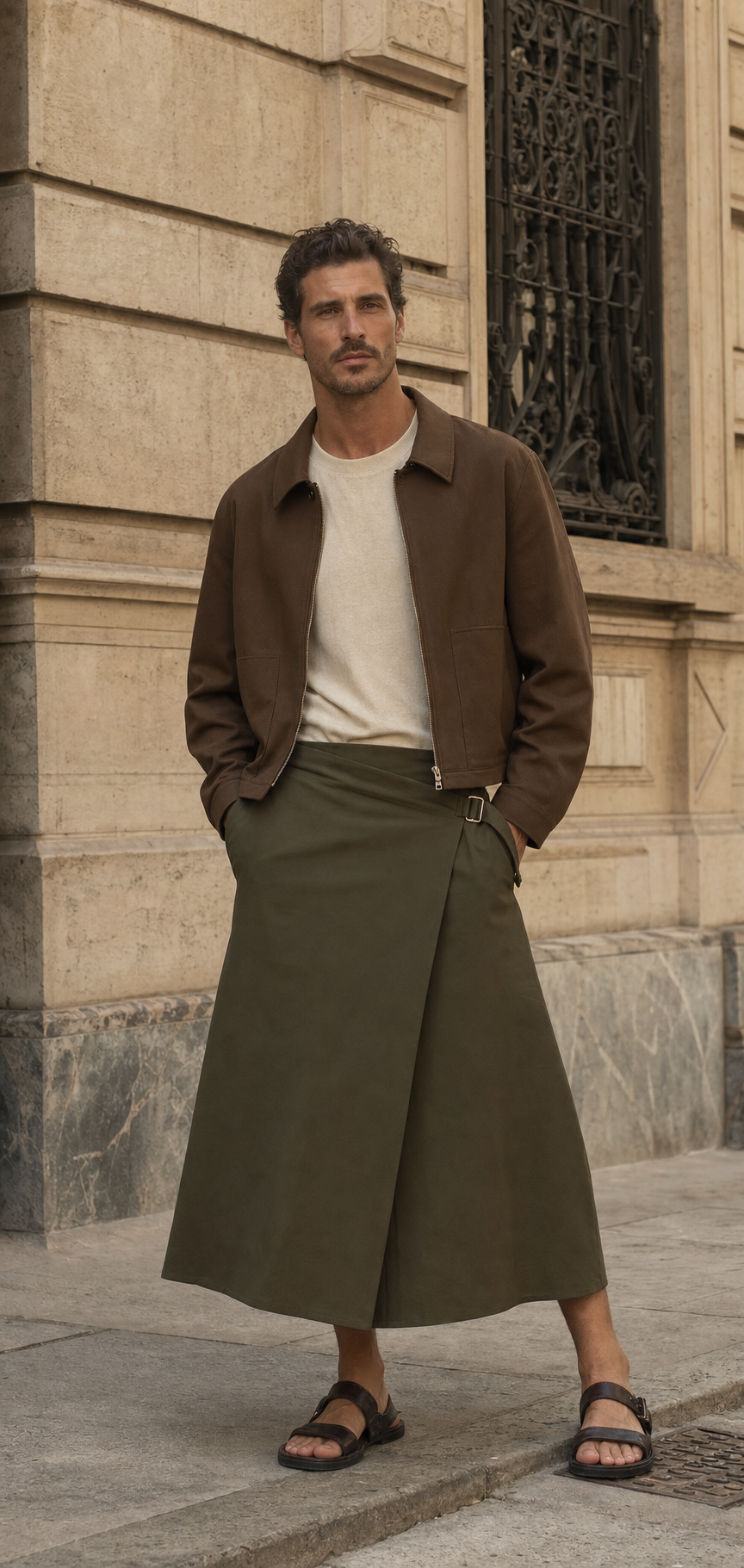
Milan: olive wrap skirt, short jacket, matte buckle
An olive wrap skirt with a clean overlap, ecru jersey, short tobacco jacket, dark leather sandals, and a single matte buckle.
It feels functional without turning tactical. That restraint is what makes utility wearable.
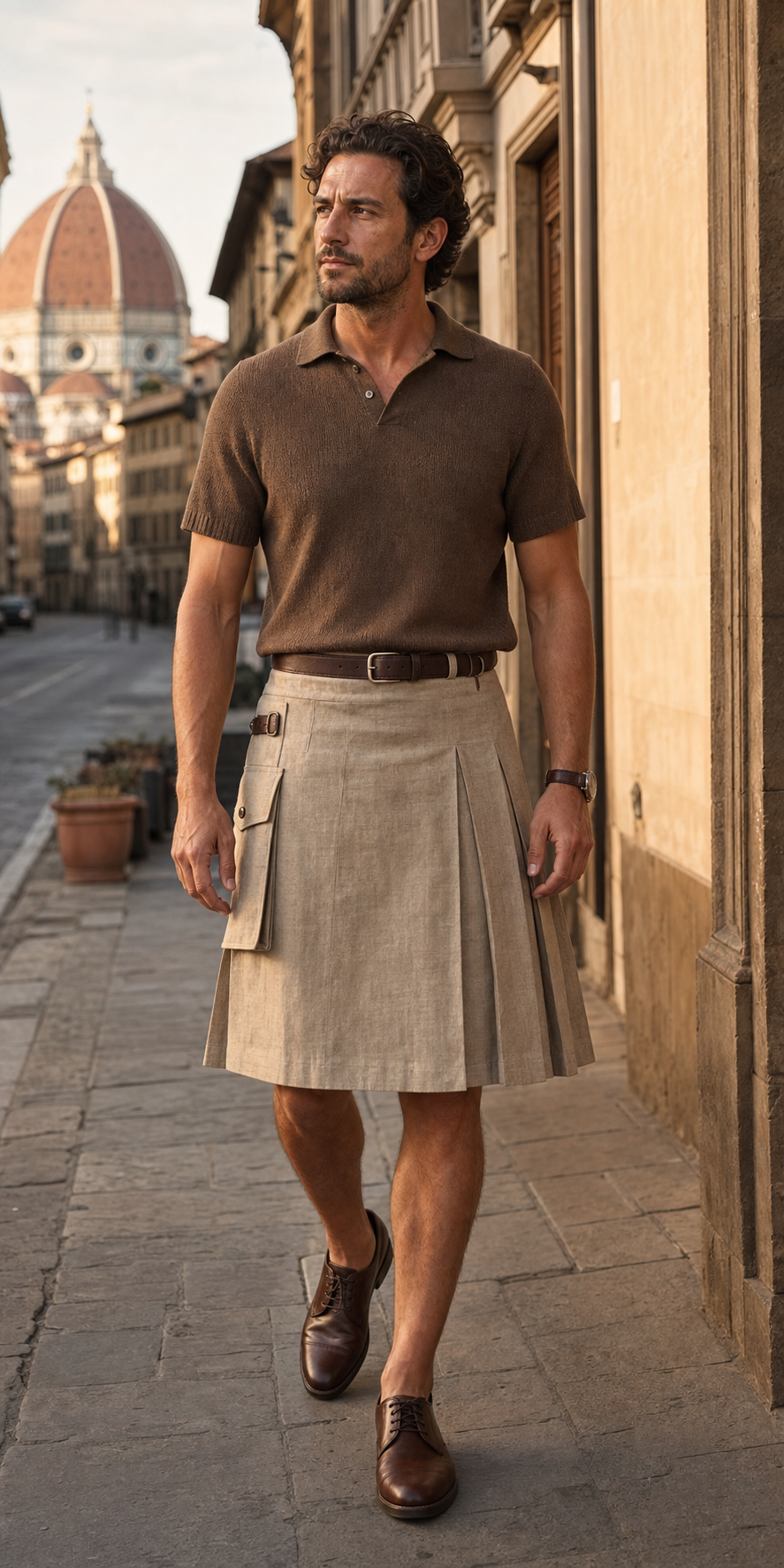
Florence: stone linen kilt with knit polo
A lightweight stone-washed linen kilt, tobacco knit polo, brown derby shoes, and a calm leather strap at mid waist.
Linen stays masculine when the kilt construction remains visible and the pleat rhythm stays clean.
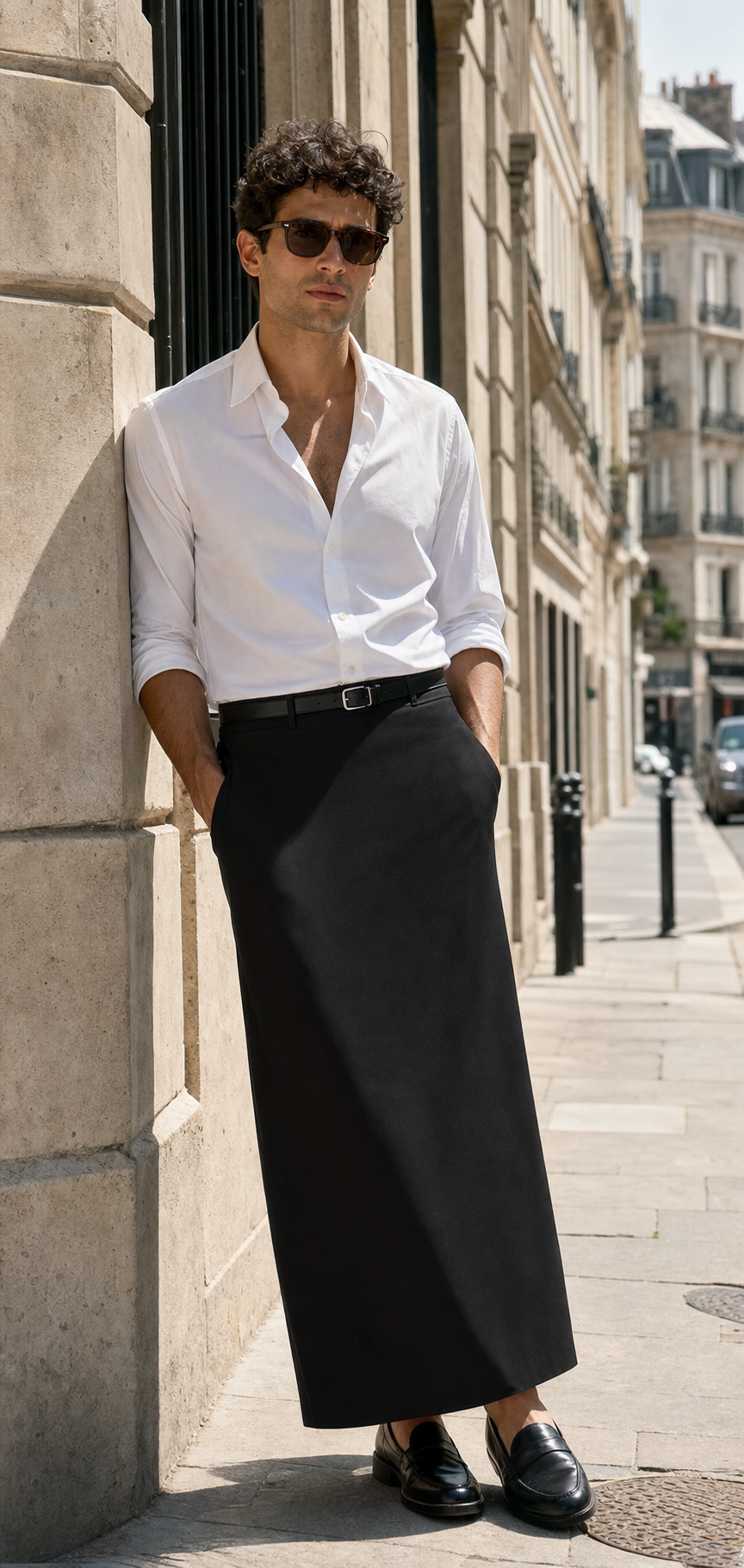
Paris: black column line with crisp shirt
A long black skirt with a smooth front, white open-collar shirt, thin belt, and slim dark shoes.
The longer line works because the front and fastening are handled with near-architectural calm.
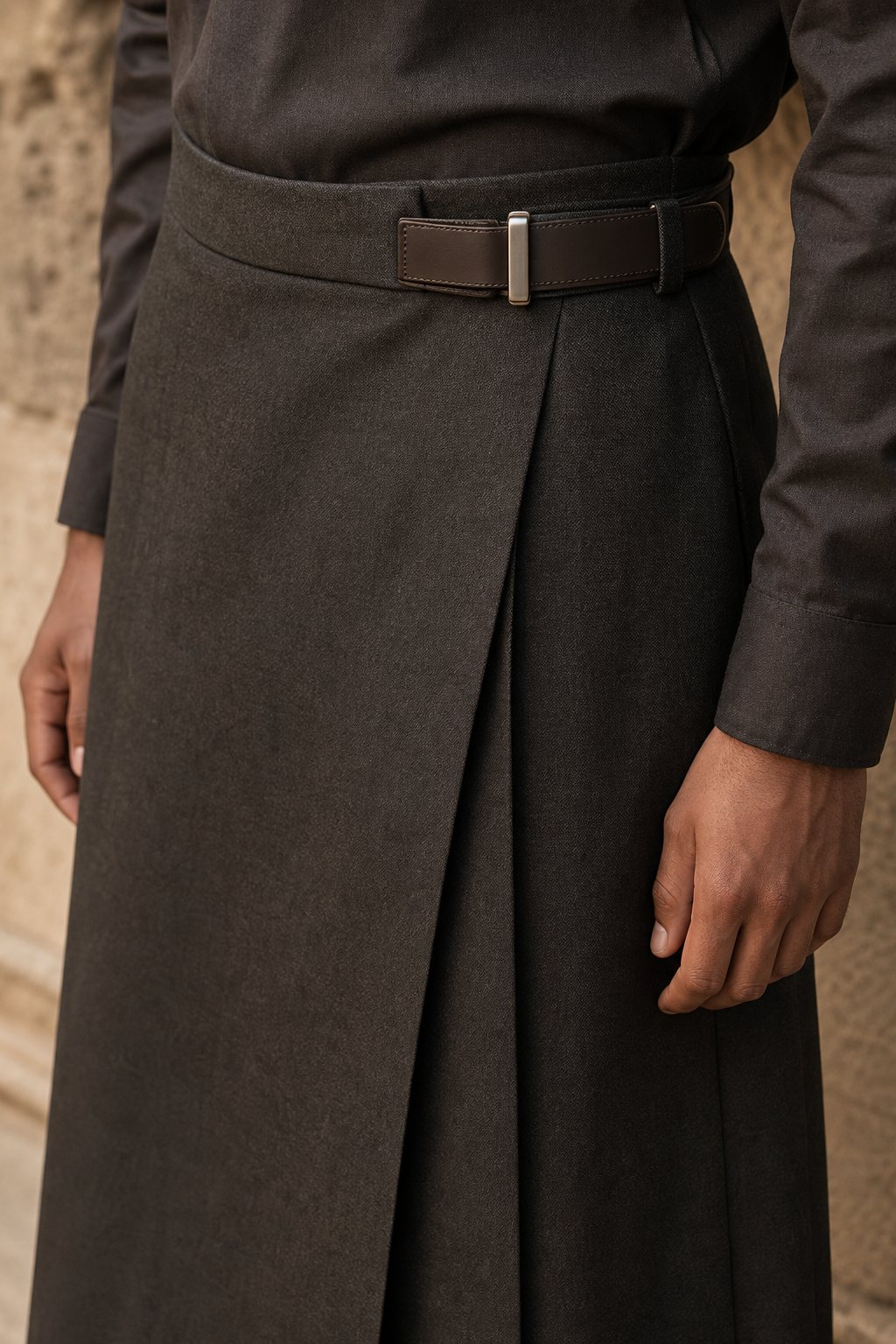
Detail study: strap, pleat, hardware
A close-up of a men’s skirt with a leather tab, tailored pleat, and restrained brushed-metal hardware.
This is where credibility is decided. One good detail is worth ten loud gestures.
Quick test: if the skirt already feels like a normal, high-quality bottom without needing a
speech, the wrap, waist, and closure are doing their job.
Sources and CTA
6) Reading list
Vogue, June 23, 2026: Frames the season around heat pragmatism, choice, and new masculine options, including Simone Rocha’s leather aprons.
GQ, June 19, 2026: Shows Rocha’s men’s proposition as apron-led, billowy, and grounded rather than merely provocative.
Wallpaper*, June 18, 2026: Focuses on menswear-specific precision, visible fastenings, and the logic of classic male forms.
GQ, June 24, 2026: Notes that Thom Browne’s kilts now sit alongside longer column and pencil skirt shapes.
Vogue Runway, June 24, 2026: Paris shows that function is accepted in heat only when it remains polished and tailored.
Vogue, June 17, 2026: Experts describe menswear as a field of broader choice and finer personal coding.
 Milan: olive wrap skirt, short jacket, matte buckle
 Florence: stone linen kilt with knit polo
 Paris: black column line with crisp shirt
 Detail study: strap, pleat, hardware